What Exactly Is a French Drain?
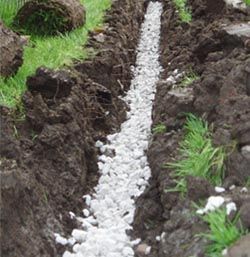
A French drain is a gravel-filled trench that contains a perforated pipe designed to redirect surface water and groundwater away from a specific area. The concept is simple — water follows the path of least resistance, and the gravel trench provides an easy channel for water to flow through. The perforated pipe at the bottom collects the water and carries it to a discharge point, usually a storm drain, dry well, or lower area of your property.
The name has nothing to do with France. It comes from Henry French, a Massachusetts farmer who popularized the technique in 1859. Nearly 170 years later, it remains one of the most reliable drainage solutions available — especially in Michigan where our clay-heavy soil creates serious water management challenges.
How a French Drain Works in Michigan's Clay Soil
Here in Oakland County, most properties sit on dense clay soil. Clay doesn't absorb water — it holds it at the surface, creating standing water, soggy lawns, and hydrostatic pressure against your foundation walls. That pressure is what pushes water into your basement.
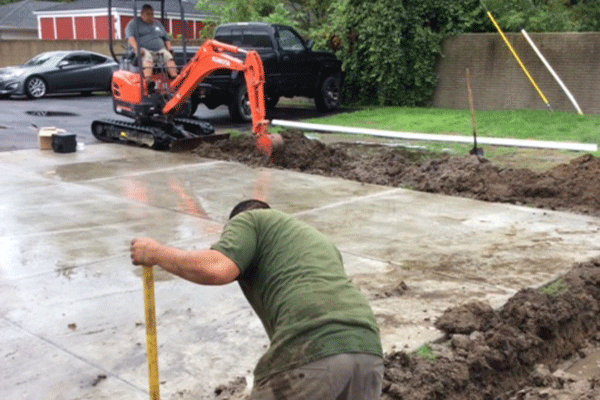
A French drain breaks through that clay layer. We excavate a trench (typically 18-24 inches deep, sometimes deeper depending on the problem), line it with filter fabric to prevent silt from clogging the system, lay a perforated corrugated pipe at the bottom, and backfill with clean washed stone. The filter fabric wraps over the top of the stone before we restore the lawn or landscape above it.
The key difference between a professional installation and a DIY attempt is base preparation and proper slope. The pipe needs a consistent grade of at least 1% slope — that's about 1 inch of drop for every 8 feet of run. Get the slope wrong, and water sits in the pipe instead of flowing out. I've repaired dozens of failed DIY French drains in Birmingham and Bloomfield Hills where the homeowner got the grade backward or used the wrong stone.
Do You Actually Need a French Drain?
Not every drainage problem requires a French drain. Here's how I assess it after 29 years in this business:
- You likely need one if: Water pools against your foundation after rain, your basement gets water during storms, your yard stays soggy for days after rainfall, or you're at the bottom of a slope where neighboring properties drain toward you.
- You might need a different solution if: Water only pools in one low spot (a catch basin might be better), your gutters and downspouts aren't properly extended (fix that first — it's cheaper), or surface grading is sending water toward your house (re-grading may solve it).
The honest answer is that many homeowners spend $5,000-$8,000 on a French drain when a $500 downspout extension would have fixed the problem. That's why we do free on-site consultations — I'd rather tell you the simple fix than sell you something you don't need. That's how you stay in business for three decades.
What About Michigan's Freeze-Thaw Cycles?
This is critical. Michigan gets 40-60 freeze-thaw cycles per winter. If your French drain isn't installed below the frost line (42 inches in Oakland County for footings, though drains can be shallower with proper design) or doesn't have adequate slope to drain completely, water trapped in the pipe freezes, expands, and can crack the pipe or heave the surrounding soil. We install with enough slope that the system drains fully between rain events, minimizing freeze risk.
Not sure if you need a French drain? Call Tony at 248-821-7188 for a free on-site assessment. We'll tell you what you actually need — even if it's not us.